Subdivision Matters: Partitioning Strategies for Task-Parallel Topological Visualization
Mithilesh Biradar (Clemson University), Guoxi Liu (The Ohio State University), Federico Iuricich (Clemson University)

Jump to Discussion
Presentation
- Session
- Connecting the Dots
- Time
- Wednesday, Nov 11, 13:36 – 13:45 (US/Eastern) · session 13:00 – 14:30
- Room
- Hall Essex north
Links
Sign in to access the Paper PDF.
- Supplemental Material(opens in new tab)
Abstract
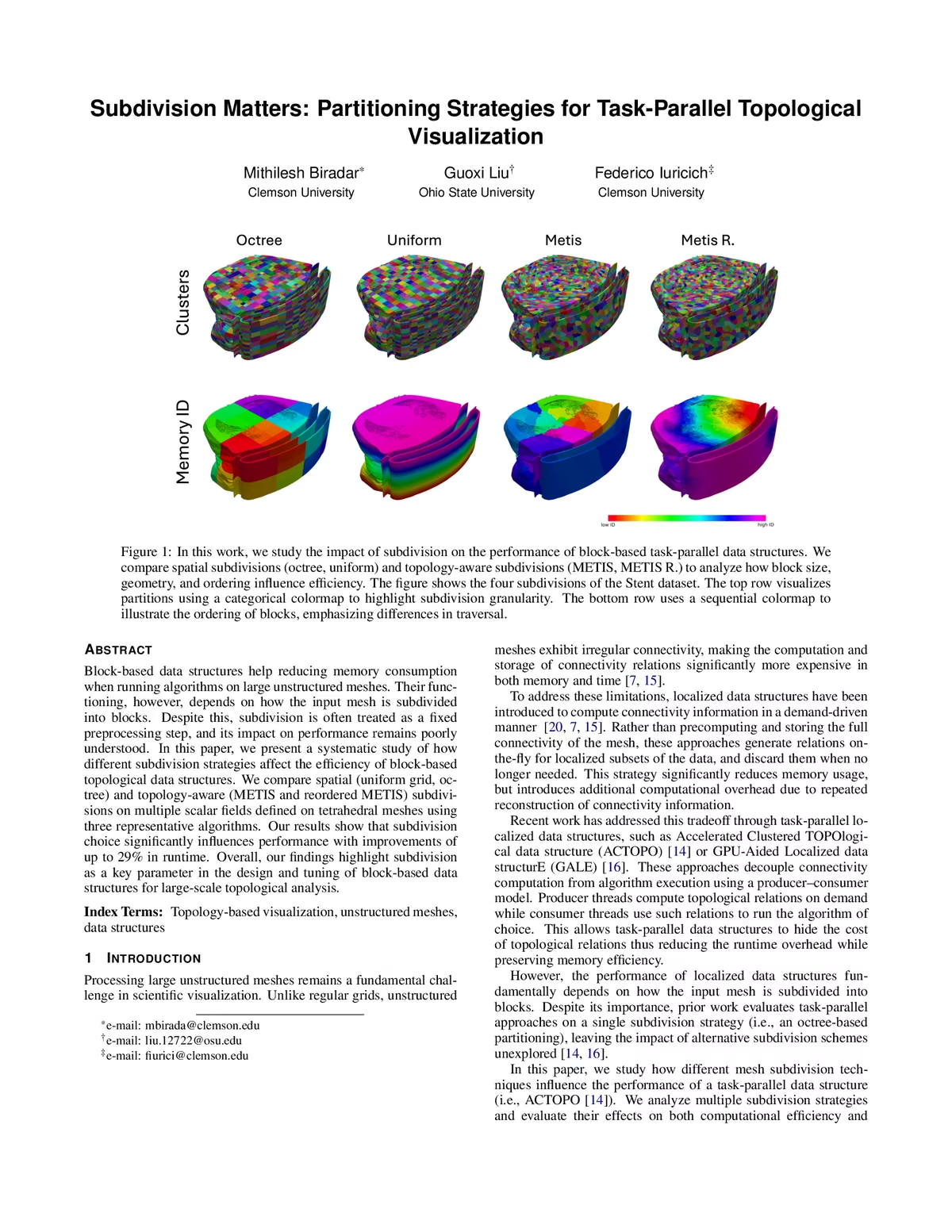
Block-based data structures help reducing memory consumption when running algorithms on large unstructured meshes. Their functioning, however, depends on how the input mesh is subdivided into blocks. Despite this, subdivision is often treated as a fixed preprocessing step, and its impact on performance remains poorly understood. In this paper, we present a systematic study of how different subdivision strategies affect the efficiency of block-based topological data structures. We compare spatial (uniform grid, oc- tree) and topology-aware (METIS and reordered METIS) subdivisions on multiple scalar fields defined on tetrahedral meshes using three representative algorithms. Our results show that subdivision choice significantly influences performance with improvements of up to 29% in runtime. Overall, our findings highlight subdivision as a key parameter in the design and tuning of block-based data structures for large-scale topological analysis.
For Practitioners
Simulation scientists and data scientists working with 3D data.